“Setting goals is the first step in turning the invisible into the visible.” — Tony Robbins, American author, entrepreneur, and life coach.
Every day, companies and teams invest valuable resources without reaching their full potential — simply because their goals are too vaguely defined. Even strong strategies lose effectiveness when there are no clear benchmarks to guide successful execution.
According to McKinsey & Company:
- Even high-performing companies experience a 30% gap between the potential of their strategies and what is actually achieved.
- A recent survey found that 72% of employees consider clearly defined goals one of the strongest motivators for improving their performance.
- Another 70% of employees say that having goals and a sense of purpose at work are the main drivers of their effectiveness.
These numbers point to a simple truth: goals only work when they are clear, measurable, and tied to a sense of purpose. That’s why the SMART method — long proven in global practice — has become a reliable tool for both business and personal development.
What Is SMART in Simple Terms?
The SMART method is a universal approach to goal setting that helps turn vague intentions into concrete outcomes. Put simply, it’s a kind of “filter” you apply to any goal to determine whether it’s likely to deliver real results.
SMART Criteria
A SMART goal stands for:
- Specific — Instead of saying “I want more clients”, you set a clear goal: “Acquire 50 new clients in the next quarter”.
- Measurable — Another smart criterion which emphasizes that success should be verifiable through numbers or metrics.
- Achievable — The goal aligns with available resources and capabilities, rather than being a far-fetched dream.
- Relevant — It matters right now and is connected to business priorities or personal development.
- Time-bound — the last smart criterion indicating that a goal needs a deadline, because “someday” often means “never”.
Together, the SMART criteria form a practical tool that helps you move forward without chaotic, wasted efforts or unnecessary strain on company resources.
Types of SMART Goals: What Can Be Measured and Achieved
To make the SMART framework truly effective, it’s important not only to formulate goals correctly but also to choose the right type of goal. Focus on six core categories:
- Increase — used to drive growth in key metrics such as sales, customer count, website traffic, and more.
Example: Increase sales by 20% over the next 3 months. - Make — ideal for launching new products, services, or internal processes.
Example: Create a new online course program by the end of the year.
- Improve — aimed at enhancing quality, whether in service delivery, productivity, or customer satisfaction.
Example: Improve order processing speed by 15% within the quarter.
- Reduce — these goals focus on cost optimization or risk mitigation.
Example: Reduce logistics costs by 10% over six months.
- Save — helps concentrate efforts on efficient use of resources such as time, budget, or materials.
Example: Save 100 work hours by automating processes within 2 months.
- Develop — the most valuable type of goal for personal and professional growth, whether for yourself or your team members.
Example: Develop presentation skills in 5 employees over the course of the quarter.
Tip: The SMART goal system works best when applied to objectives that can be achieved within a relatively short timeframe. It’s most effective for short- and medium-term goals — ranging from a week or a month to a year. This approach allows you to see quick results, adjust your strategy as needed, and maintain high levels of motivation. Large strategic plans should be broken down into smaller sub-goals, each formulated using the SMART framework. This makes the path to major achievements more manageable and easier to control.
Benefits of Setting SMART Goals
The SMART method is a powerful tool that can significantly improve the effectiveness of companies and teams, helping them achieve more while spending less time and fewer resources.
Those who already use this method in practice highlight the following key benefits of SMART goals:
- Clear focus on results — Every goal is formulated in a specific and measurable way, so the team knows exactly what needs to be achieved, what success looks like, and how it will be evaluated.
- Optimal use of resources — SMART goal setting ensures that objectives are achievable and relevant, helping avoid overload and wasted effort on ineffective activities.
- Transparency of progress — Thanks to measurable indicators, you can regularly assess interim results, adjust your strategy, and respond quickly to deviations from the plan.
- Team motivation — SMART goals provide a clear system of priorities, increase employee engagement, and make it easier to recognize even small wins along the way.
- Improved productivity and efficiency — When goals are clear, attainable, and time-bound, teams work with purpose, and the business sees consistent results.
- Structured planning — Large strategic tasks can be broken down into smaller sub-goals, each aligned with SMART principles, making the journey toward major achievements more controlled and manageable.
How to Set SMART Goals: Examples and Step-by-Step Guide
A well-formulated SMART goal is like a roadmap that takes you from idea to tangible results. To avoid vague intentions and turn your goal into a real action plan, follow this step-by-step approach.
Where to Start:
- Define the overall goal:What exactly are you aiming for? Clearly and specifically articulate the desired outcome — this will serve as your reference point and help you understand the direction to take.
- Break it down into smaller steps:This makes the path more understandable and manageable. Big goals are easier to achieve when divided into sub-goals. Each small step creates a sense of progress and helps maintain motivation.
- Formulate the outcome in a measurable format:Identify specific success indicators (numbers, timelines, volumes). This allows you to track progress and quickly adjust your strategy if needed.
Tip: Avoid vague phrases like “want to improve”. Instead, use “improve by X% by a specific date”.
Examples of SMART Goals:
- Increase the number of website leads by 25% within 3 months.
- Reduce order processing time from 48 to 24 hours over the course of a quarter.
- Develop presentation skills within the team: at least 80% of employees should complete training by the end of the year.
- Save 15% of the marketing budget by automating ad campaigns by the end of the quarter.
SMART Goal Example with Criteria Breakdown:
Goal: “Acquire 50 new clients over the next quarter”.
- Specific: The goal clearly states the number of clients, avoiding vague wording like “I want more clients”.
- Measurable: The outcome is quantifiable — the metric is already defined: 50 new clients. Progress can be tracked weekly or monthly by counting signed contracts or registered clients. This helps determine whether you’re on track and allows timely adjustments to your acquisition strategy.
- Achievable: The goal is realistic, taking into account the company’s resources, team capabilities, and market conditions. You wouldn’t set an unrealistic target like 500 clients per quarter if your current capacity doesn’t support it.
- Relevant: The goal is important to the business and directly impacts revenue and company growth. It aligns with strategic priorities.
- Time-bound: The deadline is clearly defined — the next quarter. This enables the team to organize their work and plan intermediate steps, such as:
- Assigning tasks across the team: who handles lead generation, cold calls, email campaigns, and negotiations with potential clients.
- Setting interim KPIs — for example, 15 new contacts per month, 5 presentations per week.
- Monitoring progress — regular check-ins to assess whether milestones are being met and to adjust the plan if needed.
- Evaluating interim results — analyzing conversion rates and the effectiveness of acquisition channels to refine the strategy.
- Motivating the team — introducing bonuses or incentives for achieving interim goals to maintain high engagement levels.
Comparative Table: Ineffective Goal Setting vs. SMART Method
| Ineffective Goal Setting | SMART Goal Setting |
| “Get more clients” — too vague; the team doesn’t understand the specific target and can’t plan actions effectively. | Specific: “Acquire 50 new clients over the next quarter.” |
| “We need to close projects faster” — lacks a clear metric, making progress hard to measure. | Measurable: “Reduce average project closure time from 30 to 20 days.” |
| “We need to improve team efficiency” — overly ambitious without considering resources and skills; risk of demotivation. | Achievable: “Increase lead conversion by 15%, based on available resources and team capabilities.” |
| “This goal is important for the business” — lacks a clear link to strategic priorities; the team may focus on secondary tasks. | Relevant: “The goal directly impacts revenue from the new product and aligns with the company’s strategic priorities.” |
| “Close the task as soon as possible” — no deadline; the team may delay or rush without ensuring quality. | Time-bound: “Achieve the goal by the end of the current quarter.” |
Conclusion: A step-by-step approach to SMART goal setting transforms abstract intentions into clear actions with predictable outcomes. The SMART methodology is a powerful tool for managing change and driving growth in business.
Common Mistakes and Expert Insights on SMART Analysis — Plus Practical Tips
Even when SMART tasks are formulated according to general principles, teams sometimes make mistakes during implementation and monitoring, which can reduce the method’s effectiveness. Here’s what experts recommend paying attention to:
- Insufficient SMART analysis before setting goals
❌ Mistake: The goal is set without evaluating the market, resources, or team capacity.
✅ Tip: Conduct a brief audit before defining the goal — assess competitors, available resources, and team skills. This helps set realistic and strategically meaningful SMART goals.
- Ignoring goal interdependence
❌ Mistake: Goals exist in isolation, without considering how they relate to one another.
✅ Tip: Analyze how each goal in the SMART format affects other KPIs and projects. Aligning goals helps avoid priority conflicts and ensures synergy across team efforts.
- Underestimating interim monitoring
❌ Mistake: The team waits until the deadline to evaluate results.
✅ Tip: Set regular checkpoints — weekly or monthly progress reviews allow timely adjustments and help maintain motivation.
- Lack of flexibility
❌ Mistake: The goal remains unchanged even when market conditions shift.
✅ Tip: SMART goals are not about rigid boundaries. Periodically assess internal and external factors and adjust the goal to keep it relevant.
- Neglecting communication and team engagement
❌ Mistake: SMART goals are announced as directives without team discussion.
✅ Tip: Involve the team in goal-setting — this increases accountability, engagement, and commitment to achieving results.
- Overlooking interim achievements
❌ Mistake: Focus is placed solely on the outcome.
✅ Tip: Celebrate even small wins to sustain motivation and show that every step brings you closer to success.
Even a perfectly formulated SMART goal won’t deliver results without strategic planning, monitoring, and team involvement. Taking these factors into account turns the SMART method into a true driver of business performance.
Online Tools for SMART Goal Setting: SMART HCM & LMS

To turn strategic plans into concrete actions quickly, you need a tool that automates the goal-setting process and makes it transparent, structured, and easy to understand for every employee.
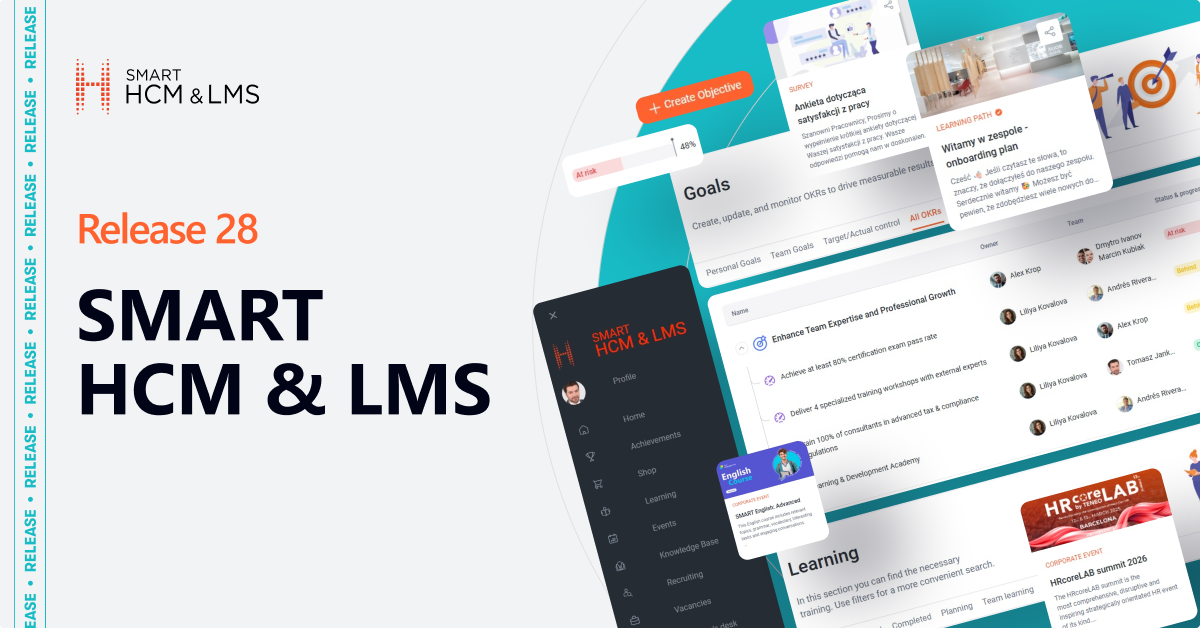
The SMART HCM & LMS platform by SMART business is a comprehensive solution for building a modern HR ecosystem. It enables seamless configuration of SMART goals, alignment with company priorities, and real-time performance tracking.
Goal Setting Module: Automation and Transparency
The Goal Setting module in SMART HCM & LMS allows you to define employee goals that are fully aligned with the company’s key objectives and to work individually with each employee to ensure their tasks support the broader business strategy.
Key features of the module:
- Goal cascading: from company-wide objectives to individual employee tasks
- Definition and approval of key performance indicators (KPIs) and their evaluation
- Real-time KPI tracking
- KPI category guide to standardize evaluation approaches
- Calculation of average productivity based on weighted significance
Benefits of the Module:
- Clear expectations for employees — The platform enables flexible goal setting at any scale — from monthly to annual targets. Each employee can independently assess their progress, confirm planned tasks, and receive feedback on results, turning goal setting from a formal procedure into a clear, motivating, and transparent process for every team member.
- Alignment with company goals — Every employee goal is automatically linked to the company’s strategic metrics, allowing not just task assignment but real-time execution monitoring. KPI and team performance tracking helps visualize how quickly the business is progressing toward its global objectives and supports timely decision-making to optimize processes and improve outcomes.
- Identifying weak spots and growth areas — With automated SMART goal tracking, it’s easy to spot problem areas and potential development zones — both at the individual and departmental level. This empowers managers to make informed decisions based on real data rather than assumptions, driving systematic improvements in team productivity.
Conclusion:
The Goal Setting Module in SMART HCM & LMS is a tool that transforms the process of setting SMART goals into a structured system that drives performance and business growth.
Frequently Asked Questions
1. What are SMART goals?
It’s a goal-setting method that makes objectives clear and easy to understand. They must be Specific, Measurable, Achievable, Relevant, and Time-bound. This approach helps avoid vague wording, keeps the focus on tangible results, and ensures effective progress toward strategic objectives.
2. Why do we need SMART goals?
SMART goals turn strategic plans into concrete, measurable outcomes: they help identify priority tasks, motivate the team through transparent expectations, enable real-time progress tracking, reveal weak points for timely adjustments, and optimize resource allocation by focusing efforts on what truly delivers results.
3. How do you define and set truly important goals?
Start with the company’s key priorities and strategic metrics: every goal should be specific, measurable, and realistically achievable, with a direct impact on business results. The SMART approach helps structure goals, set clear deadlines, define interim KPIs, and ensure transparency for the team so every employee understands why their task matters and how it contributes to the company’s overall success.
4. Why am I — or my team – not achieving the SMART goals we’ve set?
Often, SMART goals remain out of reach due to a mismatch between resources and capabilities, unclear priorities, or lack of regular monitoring and progress adjustments. Another common reason is the absence of automation and modern control tools — such as the SMART HCM & LMS platform — which allows you to track goal completion in real time, access KPI analytics, and provide timely feedback.
5. What should a SMART goal look like?
A SMART goal must be Specific, Measurable, Achievable, Relevant, and Time-bound. This means it clearly defines the desired outcome, allows progress to be tracked through measurable indicators, aligns with the team’s resources and capabilities, matches the company’s strategic priorities, and has a defined deadline. Such a goal is clear, manageable, and motivating for everyone involved in the process.
6. What does a SMART task mean?
A SMART task is a specific assignment formulated according to SMART criteria: it is clearly defined, measurable, achievable, relevant to strategic objectives, and has a set deadline.
7. What should project goals look like under the SMART method?
Project goals based on the SMART method should be clear and specific, easy to measure, realistic given the team’s resources and capabilities, aligned with the company’s strategic priorities, and time-bound.
8. How can goal setting be simplified?
To simplify the goal-setting process and avoid mistakes, companies often use a template for formulating SMART goals. This ready-made structure helps define the goal according to all criteria: specify the desired outcome, set measurable indicators, confirm feasibility, align it with strategic priorities, and establish a clear deadline. This approach saves time, makes goals transparent for all team members, and significantly increases the chances of success. With the SMART HCM & LMS platform, this process can be fully automated.