A business’s true value is the direct result of how efficiently its human capital leverages and directs its financial and intellectual capital.
How do you manage a company whose team is growing so rapidly that HR managers — and traditional management tools like spreadsheets — can no longer keep up? More often than not, business growth is not only a success but also a new challenge.
Most HR processes remain invisible until something goes wrong. At first, the issues are barely noticeable: spreadsheets are still manageable, information can still be found, and everyone still remembers the latest agreements. However, without digital tools to support them, these processes begin to break down as the company grows — affecting communication, data quality, and decision-making.
This is where HRM systems help HR teams avoid getting bogged down in routine tasks such as manually approving leave requests or repeatedly checking employee documents.
What is an HRM system?
An HRM system (Human Resource Management system) is a unified digital environment that brings together all employee management processes in one place. These solutions typically cover both core HR functions, including:
- Core HR administration
- Payroll
- Employee data management
as well as more advanced capabilities, such as:
- Recruitment
- Employee onboarding
- Performance management
- Learning and development
The real value of an HRM platform lies in shifting HR professionals away from manual administrative work and enabling them to focus on strategic initiatives. That is why HRM solutions are increasingly viewed as the digital foundation of a company’s HR function.
Key modules of an HRM system
Like any digital infrastructure, the strength of an HRM system lies in the connections between its processes. Recruitment feeds data into onboarding, onboarding passes information to core HR, and those records are then used for payroll, performance management, and learning. The result is a continuous flow of employee information throughout the entire employee lifecycle.
Modern HRM solutions typically include the following modules:
- Core HR — The foundational module that stores employee records, organizational structure, and interaction history. It serves as the single source of truth for all other HR processes.
- Recruitment — Supports the entire hiring process, from job posting and candidate tracking to recruitment analytics. Once a candidate accepts an offer, their information is automatically transferred into the HRM system.
- Onboarding — Standardizes the onboarding process by managing documentation, system access, initial tasks, and training. This reduces the administrative workload for HR teams while helping new hires become productive more quickly.
- Time & Attendance — Automates the tracking of working hours, absences, leave, and shifts. The collected data is automatically used for payroll processing and reporting, ensuring greater accuracy and transparency.
- Performance Management — Enables organizations to set employee goals, conduct performance reviews, and collect feedback. It helps align individual performance with the company’s strategic objectives.
- Learning & Development — Supports employee training, competency development, and career planning. It allows organizations to approach employee development systematically rather than addressing learning needs on an ad hoc basis.
- Employee Self-Service — Gives employees direct access to their personal information, leave requests, documents, and certificates. This significantly reduces routine HR inquiries while accelerating everyday HR processes.
- HR Analytics & Reporting — Consolidates data from all modules into reports and dashboards covering metrics such as employee turnover, productivity, and workforce trends. This is the layer that transforms HR from an administrative function into a strategic, data-driven business partner.
- Payroll — In many HRM solutions, payroll is provided either as a dedicated module or through integration with an ERP or payroll system. This integration allows organizations to use data on absences, employment changes, and working hours to improve payroll accuracy and reporting.
How to choose the right CRM system for your business
The best HRM system is not necessarily the most popular one — it is the one that best matches your organization’s specific requirements. The same platform can either become a catalyst for business transformation or create additional complexity if it fails to reflect the company’s organizational structure, workforce size, and HR maturity.
When evaluating HRM software, consider the following key criteria:
- Alignment with business processes — The system should support your existing HR processes or be flexible enough to adapt to them. Highly standardized solutions with limited customization often drive teams back to spreadsheets and manual workarounds.
- Scalability — An HRM solution should grow alongside your business by supporting workforce expansion, new markets, and increasingly complex organizational structures. Ideally, it should be modular and open to additional integrations and applications. Otherwise, you may find yourself replacing the system within just a few years.
- Integration with other business systems — An HRM system should not operate in isolation. It needs to exchange data seamlessly with ERP systems, financial applications, CRM platforms, and other business tools. The simpler and more reliable these integrations are, the lower the risk of errors caused by manual data handling.
- Ease of use — The interface and user experience should be intuitive for every employee, regardless of their technical background. Otherwise, even the most feature-rich solution may remain underutilized.
- Analytics and reporting — A modern HRM system should do more than store information. It should help organizations analyze workforce data, generate reports, identify trends, and support informed, data-driven decision-making. Its purpose is to make HR data transparent, accessible, and actionable.
- Implementation expertise and technical support — Even the best software requires successful implementation. That is why it is essential to evaluate not only the product itself but also the vendor responsible for implementation, customization, user adoption, and ongoing support.
SMART HCM & LMS: a comprehensive platform for HR process automation and talent development
The SMART business team has extensive experience implementing HRM and HCM solutions, helping organizations seamlessly integrate them into real-world business processes. This approach includes requirements analysis, solution architecture design, module configuration, and post-implementation support.
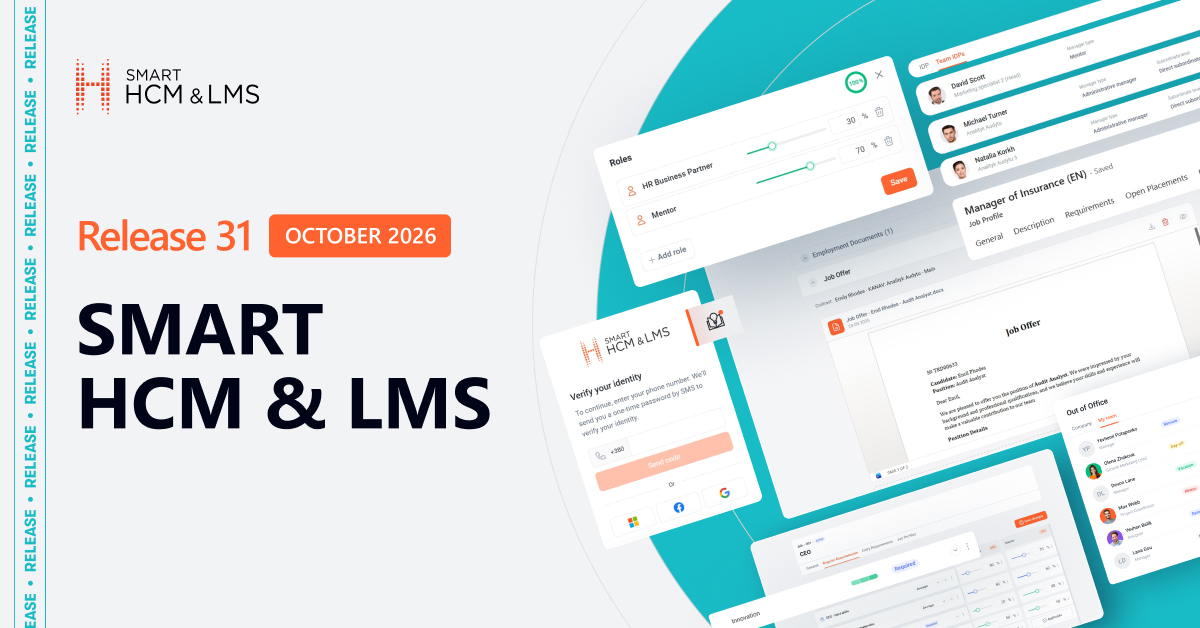
The company also offers SMART HCM & LMS — a ready-to-use, flexible platform with optional modules that can be tailored to meet virtually any business requirement. SMART HCM & LMS provides the following benefits:
- End-to-end HR process automation — The platform supports the entire employee lifecycle, from recruitment to talent development.
- A single platform instead of multiple systems — HRM and LMS functionality are combined in one integrated solution.
- 360-degree employee profile — The system consolidates all employee information, from personal data to learning achievements and performance results.
- Talent development and retention — Built-in learning, competency development, and performance management tools help organizations improve employee engagement and reduce turnover through a structured approach.
- Enhanced employee experience — The platform provides convenient access to HR services, learning resources, and internal communication, improving overall employee satisfaction.
- A data-driven approach to workforce management — Advanced analytics enable organizations to measure performance, identify potential risks, and plan workforce development more effectively.
- Flexibility and accessibility — The platform is accessible across multiple devices and channels — including web, mobile interfaces, and chatbots — making it easy for every employee to interact with the system.
Business benefits of implementing an HRM system
- Automation instead of manual processes — With a centralized employee database and automated workflow logic, HR processes no longer depend on individual employees’ knowledge or memory. Instead, they become standardized, consistent, and repeatable. (Research shows that HR automation can reduce administrative costs by at least 30%.)
- Better management decision-making — HRM consolidates data from recruitment, performance management, compensation, and other HR processes into intuitive dashboards, enabling managers to make informed decisions based on real-time data.
- Reduced operational risk — Automated calculations, validations, and approval workflows minimize human error, while centralized data storage reduces the risk of information loss and inconsistencies.
- Greater transparency for management — Managers can monitor key team metrics — including workload, performance, and organizational changes — without submitting additional requests to HR.
- A stronger employer brand — Consistent digital processes for onboarding, employee services, and internal communication create a predictable employee experience with fewer delays and less back-and-forth. This directly strengthens the company’s employer brand. (According to research, 70% of professionals feel more engaged at work when they use modern HR technologies.)
- Competency management — Performance assessment, skills development, and analytics tools help organizations identify employees’ strengths, detect skill gaps, and create personalized development plans. This enables a systematic approach to employee development rather than reacting only after problems arise.
- Scalability — Once HR processes are formalized within the system, adding new employees, roles, or departments no longer requires manual configuration each time. They simply become part of the existing business logic.
- A foundation for strategic HR — By collecting historical data and providing actionable analytics, HRM enables HR teams to move beyond operational work and focus on strategic workforce planning, forecasting talent needs, evaluating learning investments, and developing long-term workforce strategies.
HRMS vs. HRIS vs. HCM: What’s the difference?
The HR technology landscape is full of acronyms — HRIS, HRMS, and HCM — which are often used interchangeably. However, they represent different concepts, and understanding those differences is essential when selecting the right solution for your business.
- HRIS (Human Resource Information System): The foundational level of HR automation. It focuses primarily on storing and managing employee data, including personal information, organizational structure, employment history, leave records, and absences. In essence, an HRIS is a reliable system of record. While it provides a solid employee database, it offers limited support for talent development, performance management, or employee engagement.
- HRMS (Human Resource Management System): An HRMS takes a broader approach by combining employee data management with HR process automation. In addition to core HRIS functionality, HRMS solutions typically include payroll, recruitment, onboarding, performance management, and other tools required for day-to-day HR operations. This is the type of solution most organizations refer to when they talk about an HRM system — a platform that not only stores employee information but also supports and automates complex HR processes.
- HCM (Human Capital Management): HCM is a broader concept than a software system alone. It represents a strategic approach to managing human capital, encompassing talent development, succession planning, competency management, and employee engagement.
Simply put, HCM answers not only the question, “Who works in the company?” but also, “How do these people create value for the business?” That is why the term HCM system usually refers to solutions that go beyond operational HR and support long-term workforce strategy.
In summary:
- HRIS — Best suited for organizing employee data and managing core HR administration.
- HRMS / HRM — Ideal for automating the complete employee lifecycle.
- HCM — Designed for organizations focused on strategic talent management and business growth through people.
In practice, many organizations combine these approaches. When selecting a solution, it is therefore more important to evaluate the business challenges it addresses — whether operational, process-oriented, or strategic — than to focus solely on the product category or acronym.
If you have questions about selecting or implementing an HRM system, submit a request. SMART business experts will help you choose a solution that matches your business processes, organizational scale, and strategic objectives.
FAQ
What is the difference between an HRM system and a basic payroll system?
A payroll system focuses exclusively on calculating salaries, taxes, and employee payments.
An HRM system offers much broader functionality. It supports the entire employee lifecycle — from maintaining employee records to managing recruitment, onboarding, performance, and learning processes — while connecting these activities within a single platform. In this context, payroll is just one of many modules.
Can an HRM system be integrated with an ERP system?
Yes. In fact, this is standard practice for most organizations.
Integrating an HRM system with an ERP enables employee records, labor costs, organizational structures, and other business data to be synchronized across systems. This ensures data consistency between HR and finance, reduces manual work, and improves the accuracy of management reporting.