Succession planning helps a company prepare for the moment when a specialist on whom a key process or function depends can no longer perform their role.
According to Deloitte, 86% of executives consider succession planning an important or urgent priority, but only 14% believe their companies handle it well.
Instead of looking for a replacement once a vacancy appears, companies should identify potential successors in advance, develop the necessary competencies, and monitor their readiness. In this article, we’ll look at how to identify critical roles, assess candidates, build a development plan for them, and ensure business continuity.
What is succession planning, and how is it different from replacement planning?
Succession planning is a long-term HR process of preparing potential successors for a company’s critical roles. This approach helps you determine in advance which competencies and experience will be needed to perform a role in the future, assess potential candidates, and prepare them for a possible move into that position.
For example, a company might identify three potential successors for the head of a production division. One already has the necessary experience, the second needs to develop management competencies, and the third needs hands-on experience with certain processes. For each of them, the company defines the next development steps and regularly reviews their readiness.
The process is not limited to management positions either. A successor may be needed for a specialist with rare expertise, an employee who oversees an important operational process, or a professional whose knowledge and contacts are effectively concentrated in one person.
What does a succession plan include?
A succession plan records more than a list of potential candidates. It should show how prepared the company is for the loss of a specific role and what needs to be done to reduce that risk.
For each critical role, the following are usually defined:
- Risk level: how serious the consequences will be if the role becomes vacant.
- Future role profile: the required competencies, experience, responsibilities, and expected results.
- Potential successors: one or several candidates.
- Readiness level: for example, ready now, ready within 1–2 years, or needs longer preparation.
- Gaps: the knowledge, skills, or experience the candidate lacks.
- Development plan: practical experience, mentoring, rotations, training, or temporarily taking over some of the duties.
- Continuity measures: what to do if the specialist leaves the company suddenly.
- Owner and review date: who monitors the plan’s execution and when it needs to be updated.
In other words, a good succession plan answers not only the question “Who can replace this person?” but also “How ready are they, what are they missing, and what will the company do next?”
How does succession planning differ from replacement planning and emergency succession planning?
All of these processes are related, but they solve different problems:
- Replacement planning focuses on short-term cover. If an employee falls ill, goes on leave, or resigns, the company determines who can perform their duties. The person does not necessarily have to be prepared to move into that role permanently in the future.
- Emergency succession plan: needed for the scenario of suddenly losing a key employee. It defines who temporarily takes over their authority, which decisions they can make, and how to keep the critical process running without interruption.
- Succession planning works with a longer horizon. The company builds a pool of potential successors in advance, assesses their readiness, and systematically develops the necessary competencies.
In simplified terms, the difference can be put this way:
- Replacement: who will stand in for the employee?
- Emergency plan: who will take over their authority if they suddenly leave?
- Succession planning: who should be prepared for this role in the future, and how?
All three approaches can work together. For example, for the head of a production division, a company may have a temporary stand-in for unexpected absence while also developing two potential successors who can eventually take over the role fully.
How to identify business-critical roles and assess vacancy risk
Not every important position needs a separate succession plan. First, a company should identify the business-critical roles that can significantly affect operations, revenue, customers, strategic plans, or regulatory compliance.
At the same time, a role’s criticality is not necessarily determined by its place in the organizational structure. For example, a department head may have several prepared deputies, whereas a narrow-profile specialist may be the only person who knows a certain production process or holds the required certifications.
That is why, when assessing roles, it is worth looking not only at how important the role itself is, but also at how hard it will be to find a replacement and how much time a new employee will need to perform the duties fully.
Which roles need succession planning?
So it is more practical to compile a limited list of roles where the potential loss of an employee creates the greatest risk for the business.
When selecting roles, you can assess:
- business impact of the vacancy: whether an employee’s absence could halt an important process or affect customers or revenue
- difficulty of finding a replacement: how rare the required competencies are on the market
- time to full readiness: how many months or years a new employee needs to perform the role independently
- process dependence on a specific person: whether important knowledge, contacts, or decisions are concentrated in one employee
- regulatory and operational consequences: whether the role is tied to legal compliance, safety, or critical operations (for example, the person responsible for occupational safety, financial reporting, or production quality control)
- impact on strategic goals: whether losing the employee could slow down a project or area that is important to the company
For example, a company may find that its CFO has an experienced deputy who can temporarily take over the main functions. At the same time, the only engineer who maintains specific equipment has no internal replacement, and finding someone with similar expertise could take several months. In this situation, the second role may carry a higher succession risk, even though it is not a managerial one.
How to assess key person loss risk?
It is important to separate two different indicators here: the criticality of the role itself and the likelihood of losing its current holder.
For example, a role may be extremely important to the business, but its current holder plans to stay with the company for many more years. Conversely, an employee may have a high risk of leaving, but their functions can easily be handed over to another team member.
That is why the assessment can be built along two axes:
| Role criticality | Low likelihood of losing the employee | High likelihood of losing the employee |
| Low | Low risk | Medium risk |
| High | Medium risk | High risk |
For roles with high criticality and a high likelihood of losing the employee, the priority is to build a successor pool, identify gaps in their preparation, and plan their development.
This simple approach helps avoid a common mistake: building succession planning only around the most senior positions. Remember that the object of planning should be not the position itself, but the business risk that arises from its potential loss.
How to build the succession process and define a future role profile
Succession planning should be built as a sequential process, not as a one-off selection of a few candidates. For each critical role, the company first needs to understand what the role will look like in the future, then identify potential successors, assess their readiness, and define specific development steps.
In simplified form, the process can be structured like this:
identify critical roles → describe future requirements → identify candidates → assess gaps → build a development plan → review readiness regularly.
This approach ties succession planning to business development. If a company is entering new markets, adopting new technologies, or changing its operating model, the requirements for a successor’s role may change as well.
Once a critical role has been identified, you should:
- define the role: compile a list of critical positions and the risk level for each
- describe future requirements: determine which results, competencies, and experience the role will need in several years
- build a candidate pool: identify several potential successors rather than looking for a single “right” person
- assess readiness: compare the candidates’ current capabilities with the requirements of the future role
- identify gaps: record which competencies or practical experience are missing
- build a development plan: define the specific assignments, experience, and training that will help close these gaps
- review the plan: regularly assess candidates’ progress and whether the role requirements are still relevant
It is important that each stage has an owner, a deadline, and a clear completion criterion. For example, the result of an assessment should not be just a note saying “leadership skills need to be developed,” but a precisely defined gap and an action plan: gain experience managing a team of five employees, complete a management competency assessment, and act as a project manager for six months.
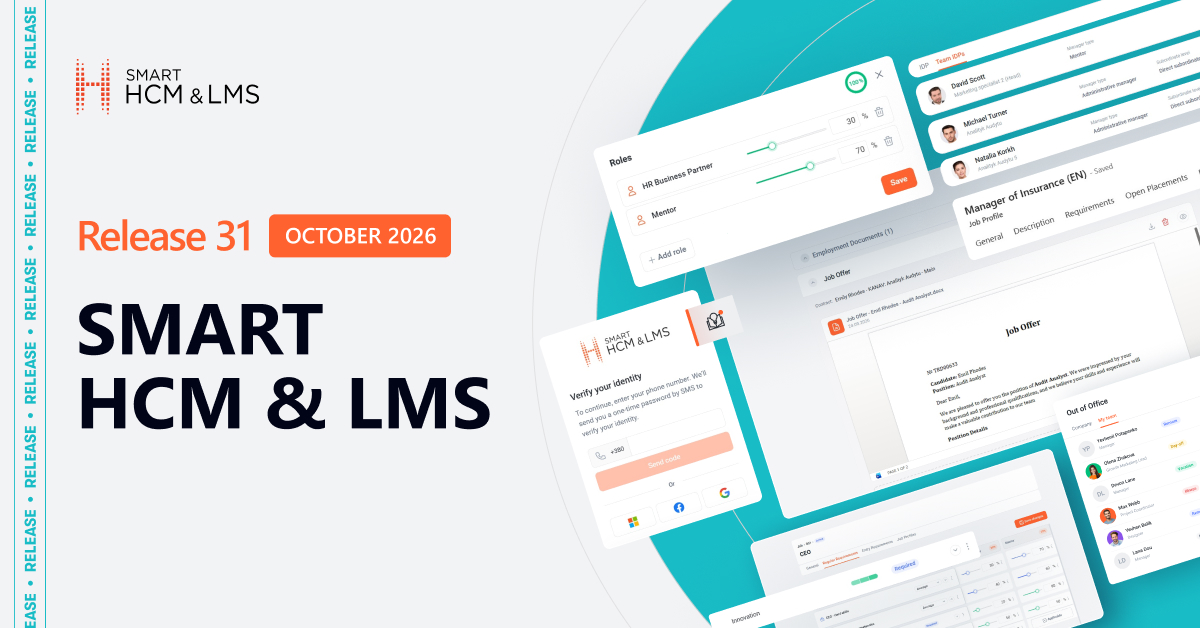
In practice, it is inconvenient to keep all this data in separate spreadsheets and documents, with assessment results stored apart from development plans, training, and information about an employee’s competencies. The SMART HCM & LMS HR platform from SMART business lets you bring these stages together in one system: assess employees, work with skills and competencies, build individual development plans, assign training through the E-learning module, and track results with HR analytics.
For succession planning, this means a candidate’s journey can be tracked as a single process: assessment → gap identification → development plan → training → reassessment → readiness monitoring. HR and the manager work with up-to-date data in one environment rather than collecting information from different files and systems. This kind of integration is especially useful when a company is working not with a single successor but with a whole pool of candidates.
What should a future role profile include?
One common mistake in succession planning is assessing a candidate by how closely they resemble the current employee. A successor does not have to copy the working style or career path of the person who currently holds the position.
Instead, a company should create a future role profile and assess candidates against it.
Such a profile may include:
- future strategy of the function: which changes are expected in the business
- expected results: what the person will be responsible for and what results are expected of them
- areas of responsibility: which decisions and processes will fall within their remit
- key competencies: professional, managerial, and behavioral
- required experience: which processes, projects, clients, or markets it is desirable to have hands-on experience with
- key relationships: which teams, managers, clients, or partners they will need to work with
For example, if in three years a company plans to actively expand international sales, the future profile of the head of the commercial function may include more than sales management experience. Working with international teams, knowledge of specific markets, managing scale-up, and the ability to work with a new business model will become important.
That is why a future role profile should describe not the current position, but what the business will need at the moment the successor takes it on. This approach makes it possible to assess candidates against the company’s future needs rather than their similarity to the current holder of the role.
How to select candidates and assess successor readiness

So, once a critical role and its future profile have been defined, the company can move on to building a successor pool.
It is important to distinguish between several characteristics:
- Performance: how consistently the employee handles their current tasks.
- Potential: whether they are able to grow and take on more complex tasks.
- Career aspirations: whether the employee is interested in moving into this role.
- Mobility: whether they are willing to change location, function, or work format if the future role requires it.
- Readiness: how close their current competencies and experience are to the requirements of the specific position.
For example, a strong team leader may have high performance and significant potential but not yet be ready to head an entire business function. If the future role requires experience managing a budget, several teams, and key clients, those gaps need to be recorded and closed before any possible move.
How to carry out a succession planning assessment of potential successors?
Assessment should be done against the profile of the specific future role. The same employee may be a promising successor for one position and not meet the requirements of another.
Based on the assessment results, candidates can be grouped by readiness level:
- Ready now: can take over the role without lengthy additional preparation.
- Ready in 1–2 years: meets most of the requirements but needs to develop certain competencies or practical experience.
- Long-term candidate: has potential but needs substantial preparation before a possible move.
For each candidate, it is advisable to record evidence of readiness and specific gaps. For example, instead of “leadership skills need to be developed,” write: “has experience managing a team of 5 people but has not managed several teams at once; next step is to lead a cross-functional project for six months.”
For this kind of assessment, a company can use performance review results, competency assessments, 360° feedback, project outcomes, and so on. This makes it possible to base decisions on facts rather than only the manager’s subjective opinion. To organize this data and take both current performance and potential into account, companies can use the 9-box grid (a performance–potential matrix).
How to use the 9-box grid in succession planning
The 9-box grid helps assess two parameters of an employee at
once: current performance and potential. The result is a matrix of nine
positions that shows who has high performance, high potential, or needs
additional attention.
Example of a 9-box grid for candidates for a management
role:
| Potential / Performance | Low performance | Medium performance | High performance |
| High potential | Megan: needs to improve results | Andrew: needs to develop management skills | Olivia: ready for active development as a successor |
| Medium potential | Ian: needs a development plan | Natalie: consistently handles current tasks | Steven: ready for expanded responsibility |
| Low potential | Peter: needs additional attention | Amanda: meets the requirements of the current role | Daniel: has high results but low potential for moving into a management role |
How to read it: Olivia is in the top right sector of the
matrix, showing high performance and high potential. The company can therefore
consider her as one of the candidates for a successor role. Andrew, meanwhile,
may need to develop management competencies before he is ready for such a role.
Daniel shows high results in his current position, but his potential for moving
into a management role is assessed as low.
For succession planning, this can be a useful succession
planning matrix for the initial selection of candidates. For example, high-potential
employees with strong performance can be included in the successor pool for
critical roles.
However, the 9-box grid should not be used as the only
criterion of readiness. High potential does not yet mean a person is ready to
perform a specific role. The candidate must also be compared against the
profile of the future position: their competencies, experience, motivation, and
willingness to take on responsibility.
So the logic can be as follows:
performance review → competency assessment → potential
assessment → 9-box grid → comparison with the future role profile → determining
the successor’s readiness.
This also helps avoid a situation where an employee ends up
in the successor pool simply because they do their current job well. High
performance in the current position does not guarantee readiness for a more
complex role.
The result of the assessment may also be a conclusion that
there is currently no ready successor within the company. This is a normal
outcome of planning, and it signals the need to widen the search, adjust the
development plan, or consider external hiring.
How to develop successors and protect business continuity
After assessing candidates, the company can see who might become a successor, how ready they are for the role, and which competencies they lack. The next step is to turn those gaps into a specific development plan.
How to create a successor development plan
A development plan should be tied to the requirements of the future role. If a candidate lacks team management experience, it is not enough to assign them a leadership course. They should also get a chance to apply what they have learned in practice.
For each candidate, you can define:
- competencies to develop: for example, team management, financial planning, or negotiation
- practical experience: participation in a project, temporarily performing some of the future role’s duties, or working in another department
- training: courses, internal programs, or microlearning that will help close a specific gap
- mentoring: work with a manager or an experienced specialist who can pass on the necessary knowledge
- readiness criterion: a specific result that shows the competency has truly been developed
For example, if a potential successor to a production manager knows the production process well but has no experience managing a team, their plan might include participating in change planning, mentoring from the production manager, and temporarily leading the team during the manager’s absence. The company then assesses not whether the candidate completed the training, but how they handled real management tasks.
This approach helps gradually prepare a successor for the future role, but succession planning and career development must also account for situations where a key employee leaves suddenly, before their successor is fully ready.
How to prepare the company for the sudden loss of a key employee
Succession planning should also include a short-term continuity scenario. For a critical role, it is worth determining in advance:
- who will temporarily take over the authority
- which decisions this person can make independently
- where key documents, contacts, and work instructions are stored
- who has access to the necessary systems and data
- who can pick up critical processes during the transition period
- how relationships with clients, partners, or other key stakeholders will be handed over
For example, if the only manager handling a major client suddenly leaves the company, the successor may not yet be ready to fully step into the position. But if a temporary point person has been identified in advance, key agreements have been documented, and contacts have been handed over, the company does not lose the client because one person is gone. This is the essence of an emergency succession plan.
In other words, employee succession planning has to work on two horizons: developing a future successor, and the company’s readiness to act tomorrow if a key employee suddenly resigns.
How to govern succession planning fairly and communicate decisions
To reduce subjectivity when choosing successors, a company should define uniform assessment rules in advance and apply them to all candidates. In practice, this means:
- using the same criteria for all candidates for a given role
- holding a joint candidate review involving HR and several managers if the role is business-critical
- not tying the assessment to the personal qualities of the current role holder, since a successor does not necessarily need the same working style
- regularly reviewing the candidate pool, as candidates’ performance, potential, and professional goals can change
At the same time, being included in the successor pool does not guarantee a promotion. It means the company is investing in the employee’s development and considers them a potential candidate for a future role.
Who is responsible for succession planning?
Several parties should be responsible for the process:
- Company leadership: identifies business-critical roles and business priorities.
- HR: coordinates the process and maintains consistent approaches to assessment and development.
- The employee’s manager: helps identify employees’ strengths and development areas.
- The employee: takes part in shaping their own development plan and defines their professional goals.
How to document, measure, and update succession plans
A company needs to regularly check whether its succession plan actually reduces staffing risks. To do this, it is worth tracking several indicators: how well critical roles are covered by successors, how quickly candidates reach the required readiness, and whether development programs lead to actual appointments.
Which succession planning metrics should you use?
The set of KPIs can be adapted to the size of the company and the number of critical roles. It is useful for a company to track the following:
| Metric | What it shows |
| Share of critical roles with a ready successor | How well protected the company is against the loss of key employees. |
| Number of candidates per critical role | The depth of the talent pipeline and dependence on a single successor. |
| Average time to readiness | How long it takes to prepare a candidate to move into the role. |
| Candidates’ progress in development plans | Whether the identified gaps in competencies and experience are shrinking. |
| Share of internal appointments to critical roles | Whether the talent pipeline works in practice, not just on paper. |
| Number of critical roles without a successor | Where the biggest staffing risks remain. |
To track these metrics without additional manual analysis, SMART HCM & LMS lets you see the dynamics of employee development and their assessment results. The platform helps HR identify in a timely way which candidates are approaching readiness, who is not showing the expected progress, and for which critical roles additional successors need to be found or developed.
When should you review a succession plan?
The main reasons for a review may include:
- a change in the company’s strategy or business model
- a reorganization or change in the structure of departments
- the departure, transfer, or promotion of a key employee
- a change in the requirements for a critical role
- a significant change in a candidate’s performance or potential
- a change in an employee’s career plans
- the completion of an important stage in a successor’s development
For critical roles, it makes sense to set a regular review cycle, for example once a quarter or every six months. If data on assessment, development, and training is stored in a single system, HR can more quickly see that a candidate no longer meets the role’s requirements, that their readiness timeline has shifted, or that the company needs to expand its talent pipeline.
FAQ: Succession Planning
Should employees be told they are potential successors?
This decision depends on company policy, but if employees know their status, their development plan can be tied directly to the requirements of the future role. At the same time, it is important to clearly separate a potential appointment from a guaranteed promotion.
Is the 9-box grid sufficient for assessing a successor?
No. The 9-box grid helps structure the assessment of performance and potential, but it does not cover all the requirements of a specific role. That is why it should be supplemented with an assessment of the candidate’s competencies, experience, professional goals, and readiness.
What should an organization do when no internal candidate is ready?
The organization needs to determine whether the candidate’s gaps can be closed through development within a timeframe acceptable to the business. If not, it is worth considering an external search while recording the role as a staffing risk.
Conclusion
Succession planning helps companies identify staffing risks in advance, prepare successors, and keep critical processes running without interruption. SMART business implements solutions built on Microsoft technologies that help you systematically assess employees, develop competencies, and monitor candidates’ readiness for future roles. This gives the company a single environment for managing talent development and lets it respond to staffing risks faster. Request a consultation, and we will help you choose and implement a succession planning solution for your company.