Companies that fail to shorten their recruitment cycle lose out both in terms of time and talent — directly affecting how quickly vacancies are filled and how productive teams are. According to McKinsey research, only 46% of hires in Europe are considered successful, meaning that fewer than half of new employees remain with the company after the probationary period and meet their employer’s expectations. Meanwhile, the candidate offer acceptance rate stands at just 56%. Low hiring effectiveness is partly due to the fact that recruitment is still relying on outdated approaches: lengthy hiring funnels, manual screening, and endless approval processes — while candidates can move on with just a few clicks. According to the same study, most HR departments have yet to fully realize the potential of modern tools, including AI. At the same time, strategic talent planning remains underdeveloped in many companies. While 73% of organizations conduct operational workforce planning to address current needs, only a small proportion take future skills requirements or long-term business development scenarios into account. For example, in the US, only 12% of HR leaders plan their workforce resources more than three years ahead. This gap between short-term planning and long-term needs means that companies do not always know what kind of talent they will need in the future. As a result, recruitment teams struggle to build a strong candidate pipeline quickly, slowing down the hiring process — particularly in organizations with high-volume recruitment or seasonal hiring demands.
These figures highlight the need for a more systematic approach to recruitment, with automation of routine stages, transparent analytics, and AI-powered tools that help recruiters work more efficiently with large volumes of candidates.
Challenges, Needs, and HR Market Trends in Poland
Just a few years ago, digitalization was largely about speeding up routine processes — for example, when a system simply screened CVs based on keywords or sent deadline reminders. Today, the focus has shifted toward even closer collaboration between people and technology.
This includes algorithms that help recruiters identify which candidates are more suitable for an interview, analytics that help predict employee turnover, and HR platforms that use employee data to recommend personalized development opportunities. In other words, while automation used to focus on executing instructions, AI has transformed technology into a full-fledged partner that helps people make decisions faster and more accurately.
According to the Human Capital Trends 2025 report, 52% of Polish companies with more than 100 employees currently use at least one AI-powered solution, and this share continues to grow. At the same time, business leaders emphasize that AI does not replace a recruiter’s expertise — it enhances it. AI tools can help recruiters analyze CVs faster, match candidates’ skills against job requirements, identify gaps, and create a more informed shortlist. AI provides more data for the initial candidate assessment, including skills match, gaps, relevant experience, explanations of the match score, and more. In addition, HR analytics gives recruiters more facts and fewer assumptions, making hiring and development decisions faster and more accurate.
As a result, in this new paradigm, the recruiter is moving from the role of a “process executor” to an architect of the candidate experience — someone who designs the candidate’s journey with the brand while maintaining a balance between automation and human interaction. For example, AI tools and HR platforms can do more than simply sort CVs automatically: they can also help create a personalized communication journey for each candidate. A system can help recruiters work with candidates more efficiently by structuring CVs, assessing their fit for a position, preparing interview questions, and maintaining communication through notification templates. All of this reduces routine work while leaving the most important part to the recruiter: human interaction and an understanding of context, both of which are essential for building trust.
In addition to the concept of co-intelligence — the joint use of human and artificial intelligence to support decision-making — several other key trends can be identified in Poland’s talent market. These trends are emerging in response to the industry’s current challenges.
- AI-powered automation frees people up for strategy, rather than replacing them — The EY 3R w HR 2025 study confirms that 42% of Polish companies have already automated part of their recruitment process, from initial CV screening to video interviews. Specialized solutions take over routine tasks, while HR teams focus on strategic areas such as employer branding, talent development, and internal mobility — moving from one team to another where similar skills are required, progressing to a higher-level position, taking on temporary rotations, and so on. Automation does not “reduce headcount”; instead, it gives HR professionals more time to think strategically about how to attract, retain, and unlock the potential of their teams.
- The key recruitment challenge is a slow time-to-hire and inefficient collaboration between HR and hiring managers. In practice, the scenario is straightforward: a recruiter sends a shortlist of candidates, the manager takes a week to provide feedback, and new vacancies are opened in the meantime — by then, a candidate who was ready to move forward may have accepted an offer from a competitor.
Integrated HCM/LMS platforms can address these bottlenecks systematically. Imagine this: a recruiter creates a vacancy, the system automatically notifies the responsible manager in Microsoft Teams, and candidate approvals take place without email exchanges or Excel files — directly through a shared system dashboard. CV data, assessments, and feedback are collected in one place, while analytics show exactly where decisions are getting stuck.
As a result, approval times can be reduced from several days to just a few hours, while overall time-to-hire is shortened without compromising the quality of the selection process. This once again confirms that the speed of decision-making has become a key factor in business competitiveness. - Clear and accurate data and analytics as the new HR currency — In an industry where every recruitment decision affects profitability and employee turnover, data is becoming the new HR currency — a measure of efficiency and an organization’s strategic maturity. At the same time, according to ABSL’s Business Services Sector in Poland 2024 report, 70% of BPO (Business Process Outsourcing) and SSC (Shared Services Center) organizations in Poland already collect HR analytics, but only 23% actually use it to support decision-making. This means that most organizations have a “data deposit” that is not working for them. In other words, their data remains a “dead asset,” generating little value — like money sitting in an account without being invested.
Companies that have learned to turn analytics into action are already gaining an advantage: they can see which recruitment sources deliver the strongest candidates, which skills are becoming critical, and when turnover risks can be anticipated. Modern HR systems with analytics modules and AI-powered tools can process large volumes of data automatically, forecast skills needs, assess the effectiveness of recruitment channels, and identify potential risks before they become problems. - A skills-based approach — In Poland, an increasing number of companies are moving away from the traditional approach of “hiring for a specific position” and focusing instead on candidates’ skills, competencies, and potential. In other words, what matters is not the job title or formal CV, but the specific skills a person can apply across different roles. This makes it possible to build dynamic teams where employees can move between projects and roles based on their strengths. Modern HR platforms such as SMART HCM & LMS help companies manage employee skills, learning, and development within a single system, creating a foundation for internal mobility and more effective use of existing talent. Instead of always looking externally, HR can make better use of the resources already available within the organization, reducing the time and cost of hiring.
- Сandidate experience = employee experience — According to the EY 3R w HR 2025 study, Polish candidates expect more than a bureaucratic process: they want a genuine service experience, with quick responses, transparent stages, and personalized communication. Modern HR tools such as AI chatbots, automated notifications, and integration with Microsoft Teams or Outlook allow candidates to receive instant answers to frequently asked questions, interview reminders, and preparation materials. This creates a sense of ease, control, and care even before the first day at work.
- HR tools that help teams prevent employee turnover — Data from HR and LMS systems is becoming a powerful tool for predicting and managing employee turnover. Modern platforms can integrate data on learning, skills assessments, and employees’ career paths, enabling HR professionals to identify potential turnover risks at an early stage. For example, if the system shows that a group of specialists has not recently participated in development initiatives or undergone competency assessments, HR can proactively offer them relevant courses or internal assignments that encourage professional growth. This allows the company to retain valuable specialists and reduce the likelihood of them leaving due to a lack of development opportunities or a sense of stagnation.
- HR as a strategic business driver — According to the findings of Deloitte’s Human Capital Trends 2025, HR is moving from the concept of “Human Resources” toward “Human Performance Systems” — becoming a system for managing people’s performance and contribution to the business. The HR focus is shifting toward analyzing and developing human potential: assessing skills, identifying critical competencies, forecasting team needs, retaining key employees, and optimizing productivity. Therefore, the “Human Performance Systems” approach must be supported by a technology-enabled strategy in which AI, data, analytics, and automation help HR build strong teams.
Everything that defines recruitment effectiveness today — speed, quality, analytics, and agility — is already built into the SMART HCM & LMS solution.
From trends to practice: How SMART HCM & LMS enables AI recruiting
The Recruiting module in SMART HCM & LMS includes AI-powered capabilities that help automate CV processing, speed up initial screening, and make recruitment decisions more transparent. Let’s take a closer look at the platform’s key functionality and see how AI-powered recruiting works in practice.
Match & Rank — Automated Skills Matching
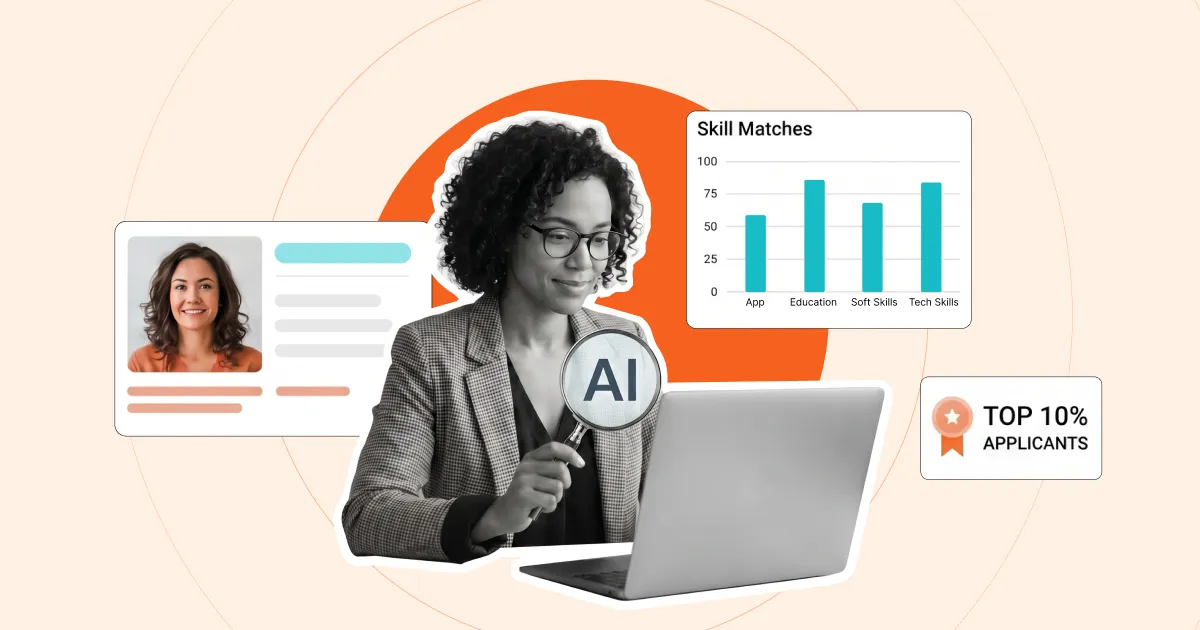
The module automatically converts CVs into structured profiles, compares candidates’ skills with job requirements, and generates a match score. Instead of endlessly reviewing CVs, recruiters can immediately see which candidates rank highest and why, with an explanation of key matches and gaps.
How it works: The system extracts data from CVs, standardizes skill and experience names, applies a matching model, and then presents the results with supporting explanations. For example, if Power BI is a key skill for a position, the system will identify not only candidates who explicitly mention this technology but also those with related competencies, such as data visualization or DAX (Data Analysis Expressions).
As a result, recruiters are less likely to overlook a valuable candidate who simply described their experience using different terminology.
Smart Talent Pool — An Intelligent Talent Database
Your entire candidate database becomes a dynamic, searchable talent pool. HR professionals can quickly find the right specialists by keywords, skills, or experience — even if they applied several months ago.
How it works: The system automatically indexes candidate profiles, tags skills, and creates flexible search filters. For example, if a new Data Analyst position opens, an HR specialist can simply enter “SQL” or “Visualization,” and the system instantly displays all relevant candidates already in the database.
This can significantly reduce time-to-hire and lower reliance on external recruitment platforms. For companies with a smaller number of recruitment processes, the SMART business team can also adapt the solution to their needs — for example, by creating a custom chatbot to collect candidate information or integrating the system with existing data tables.
Hiring Analytics — Transparency at Every Stage
SMART HCM & LMS provides comprehensive analytics on candidate quality and recruitment bottlenecks. The system shows how many candidates actually meet the requirements, where the process is getting delayed, and which channels deliver the strongest candidates.
How it works: AI aggregates candidate statuses, evaluates quality metrics, and generates clear reports for HR professionals, executives, and hiring managers. For example, the system can show that most candidates from a particular platform fail to pass the technical assessment. This insight can then be used to adjust recruitment sources or the selection approach. With AI, recruiters gain actionable insights that help reduce time-to-hire and improve the quality of candidate selection.
The full AI recruiting cycle in SMART HCM & LMS
The system brings all recruitment stages together into a single, clear, and manageable workflow — from the first CV to the final analytics report. Schematically, it looks like this:
- Import → The recruiter uploads CVs → The system instantly recognizes the data, structures it into a candidate profile, and populates key fields such as skills, experience, education, and contact details.
- Screening → AI creates a shortlist with explanations: the algorithm scores candidates and determines their level of fit with the job requirements (% match) → The recruiter sees not just a ranking, but also why a candidate ranks highly: which skills match and where the gaps are.
- Recommendations → Based on candidate data, the system suggests recommended interview questions or next steps, such as clarifying experience, assigning a test task, or assessing soft skills.
- Action → The recruiter uses the recommendations, schedules interviews, updates candidate statuses, and moves candidates through the selection stages — all within a single system, without spreadsheets or chaotic email threads.
- Enrichment → Every interaction adds new data to the candidate pool, expanding the database for future hiring.
- Overview → Analytics shows candidate quality and source effectiveness, including job portals and social media, and helps evaluate the recruitment funnel as a whole.
The statistics speak for themselves. According to Wifitalents, an international platform specializing in labor market, recruitment, and HR technology research, AI-powered solutions such as SMART HCM & LMS can reduce time-to-hire by up to 50%. Meanwhile, a 2025 study by German market research and marketing analytics company Gitnux reports that such solutions deliver 45% higher accuracy than traditional methods, while 66% of candidates prefer AI-based assessments because they consider them more transparent and fair.
Leading European and global brands such as PZU, Modern Expo, McDonald’s Georgia, Zolva Group, and others are already using SMART business solutions with built-in AI tools. If you would like to learn how AI-powered tools can help your company build a modern recruitment model where speed, accuracy, and human interaction work in synergy, request a free demo of the SMART HCM & LMS platform. The SMART business team will demonstrate how the platform can be adapted to your specific processes and needs, so you can immediately see its practical value for your organization.