Today, HR teams operate in an environment where the number of tools, data sources, and approaches is constantly growing. Recruitment, development, performance management, and internal communications — each of these areas evolves independently, creating an increasingly complex operational landscape.
Against this backdrop, the role of HR systems is also changing: they are no longer limited to storing data or automating individual processes. Instead, they are expected to provide end-to-end coverage — the ability to support the entire employee lifecycle, from the first contact with a candidate through development, evaluation, and daily team interaction.
That is why the latest updates in SMART HCM & LMS are focused on a comprehensive expansion of the platform’s capabilities. The new features address several key directions in the evolution of modern HRM systems:
- use of AI for working with candidates and reducing recruiters’ workload
- building a controlled and scalable recruitment funnel
- transparent goal management and employee development
- simplifying daily HR processes without losing control
Below is a selection of the latest updates that demonstrate this platform evolution in practice.
AI + RECRUITMENT
Feature #1: AI resume parsing (powered by ChatGPT)
What has changed?
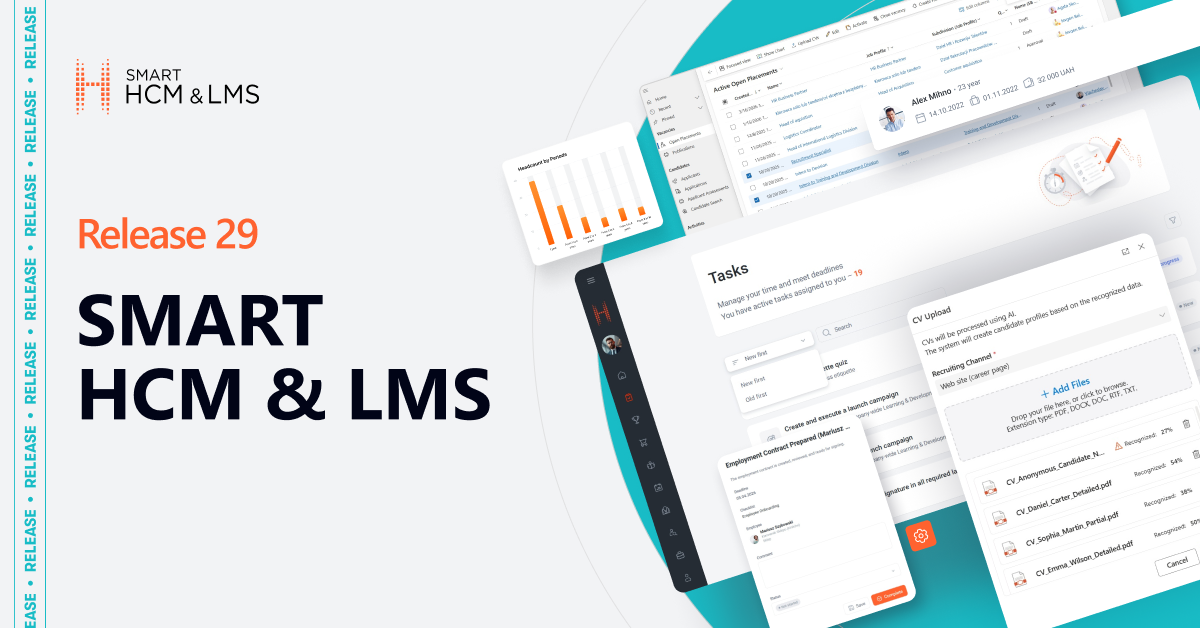
SMART HCM & LMS now includes intelligent resume parsing that enables the system to work with candidates regardless of the format and structure of their CVs. The system does not simply read text — it interprets the document’s content, identifies key sections, understands context, and prepares data for further processing within the system.
How does it work?
After uploading a file (.doc, .pdf, .xlsx, .html), the system:
- analyzes the resume structure regardless of formatting
- extracts key sections: experience, education, skills
- interprets content in context
- generates a structured candidate profile
This allows even non-standard or complex resumes to be processed correctly without manual parsing.
Business impact
- reduced time spent processing incoming resumes
- improved data quality and completeness in the system
- reduced dependency on CV format
- recruiters work with structured information instead of files
The resulting structured information becomes the foundation for further work with the candidate in the system.
Feature #2: AI-powered automatic candidate profile creation from resumes (powered by ChatGPT)
What has changed?
Based on the parsed resume, the system automatically creates a candidate profile in SMART HCM & LMS. Data no longer needs to be entered manually — it is immediately structured and becomes available for use across all related processes.
How does it work?
After processing the resume, the system:
- populates contact details, work experience, education, and skills
- automatically fills in the corresponding candidate profile fields
- synchronizes information with applications and other related entities
- tracks changes via audit and flags missing required data
If the candidate already exists in the system, a new application is created without duplicating the profile.
Business impact
- reduced manual workload for recruiters
- a structured and up-to-date candidate database
- fewer data entry errors
- faster processing of large volumes of candidates
Once the profile is created, the system can move to the next stage — assessing the candidate’s fit for the role.
Feature #3: AI-based candidate-to-job fit assessment
What has changed?
The system now includes an AI analysis tool that evaluates how well a candidate matches a job’s requirements based on their structured profile.
The system generates an overall candidate score on a 0–100 scale, provides a brief explanation, and suggests relevant interview questions.
How does it work?
Based on profile data, the system:
- analyzes the candidate’s experience, skills, and context
- matches them against job requirements
- generates a fit score (0–100)
- displays the result using a clear visual scale
- generates follow-up interview questions
The score does not replace the recruiter’s decision but establishes consistent initial screening logic and helps quickly focus on the most relevant candidates.
Business impact
- reduced time for initial screening
- less subjectivity in candidate selection
- a unified evaluation approach across the team
- faster transition from CV review to interview
Feature #4: Mass recruitment
What has changed?
SMART HCM & LMS introduces a dedicated approach to organizing high-volume recruitment through hiring projects. This enables teams to handle large candidate pipelines within a single campaign, without strict linkage to a specific job opening or department.
How does it work?
The recruiter creates a hiring project within which they:
- publish job postings via available channels
- centrally collect all candidate applications
- work with a unified candidate pipeline regardless of source
Hiring managers gain access to candidate profiles, can review statuses, and provide feedback directly in the system. Once approved, a candidate is linked to a specific position or request.
Business impact
- simplified management of large-scale campaigns and internships
- improved control over high-volume candidate pipelines
- reduced fragmentation across multiple job openings
- faster collaboration between recruiters and hiring managers
This approach creates a single point of interaction for working with candidates and lays the foundation for further recruitment funnel management.
Feature #5: Advanced candidate search by keywords
What has changed?
Search capabilities in the Recruitment module have been enhanced with the “Candidate Search” tool. The search is performed using keywords, and the results are displayed in a convenient table format. This enables working with the candidate database as a full-fledged search system.
How does it work?
Recruiters can perform keyword searches using logical operators (AND, OR, NOT, exact match).
The system searches for relevant information in:
- AI-parsed resume data
- candidate applications
- evaluations
- manually filled fields
Results are displayed in an interactive table with the ability to:
- filter and sort
- customize columns
- quickly navigate to candidate profiles
- perform bulk actions
If the number of results exceeds 500, additional results can be loaded. The data indexing date is also displayed in the list.
Business impact
- reduced time spent searching within large candidate databases
- improved accuracy when building shortlists
- greater control over internal candidate databases
- reduced dependency on external sources
Combined with the previous tools, this enables not only efficient processing of new applications but also effective use of the existing candidate database. This accelerates time-to-hire and talent pool management.
Feature #6: Integration of SMART HCM & LMS with Djinni
What has changed?
A full integration with Djinni — a Ukrainian job marketplace for IT professionals with access to the international talent market — has been implemented. The integration allows recruiters to publish vacancies, manage them, and receive candidate applications directly within the system.
How does it work?
After enabling the integration, recruiters can:
- create and publish job openings or hiring projects
- receive candidate applications directly in the system
- automatically process candidate data using AI functionality
- synchronize statuses between systems
If a resume is not provided, the system uses the candidate’s profile data. If a file is attached, AI processing is triggered to automatically create a profile.
Business impact
- centralized management of external recruitment channels
- reduced time for publishing vacancies and processing applications
- up-to-date candidate statuses across systems
- reduced risk of data loss
PERFORMANCE & DEVELOPMENT
Feature #7: OKR — from goal setting to measurable results
What has changed?
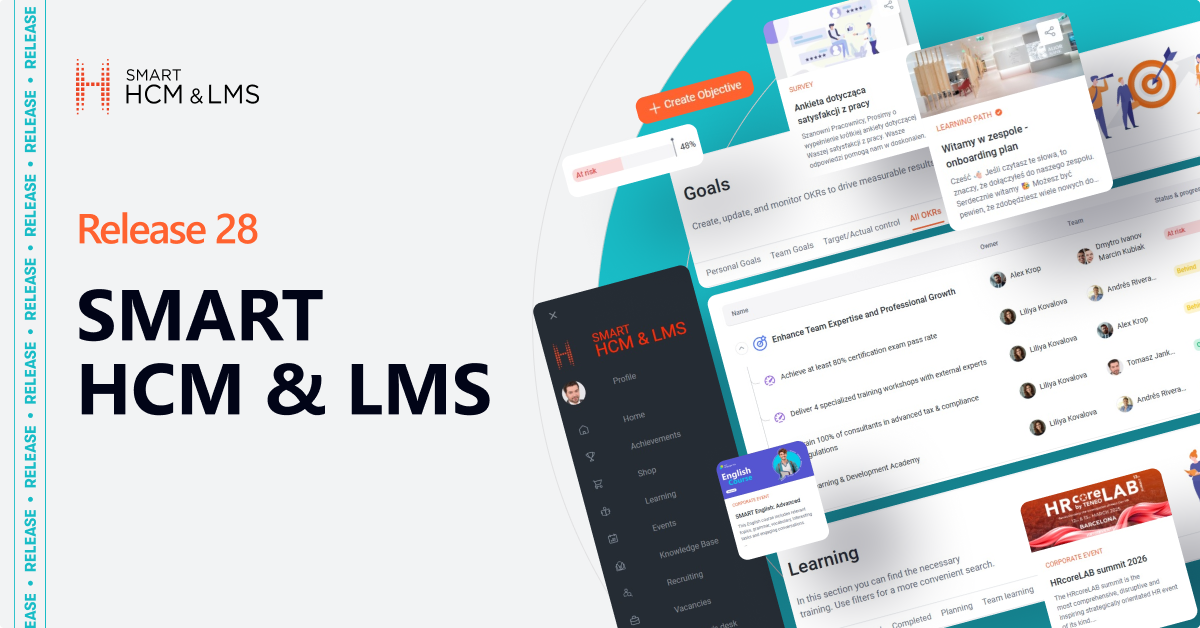
SMART HCM & LMS now includes an OKR (Objectives and Key Results) management tool that enables centralized control over goals, their structure, and progress. Goal setting, performance tracking, and regular check-ins are now handled within a single system — without the need for spreadsheets or external tools.
How does it work?
The system supports a multi-level goal hierarchy, allowing alignment between individual, team, and company OKRs.
Users can:
- create objectives, key results, and initiatives
- assign owners and teams
- define periods and weightings
- update progress manually or automatically
- track performance status based on actual data
The interface provides a quick overview of status, recent updates, and progress dynamics without the need to open each goal individually.
Business impact
- increased transparency of goals at all levels
- better understanding of individual and team contributions
- reduced gap between planning and execution
- real-time visibility into performance for managers
This enables a shift from formal planning to systematic performance management.
Feature #8: 1-on-1 meetings — transparent communication and team development
What has changed?
SMART HCM & LMS introduces built-in functionality for conducting 1-on-1 meetings within a unified system. Managers and HR teams gain a tool for planning meetings, documenting outcomes, and following up on agreements.
How does it work?
A dedicated 1-on-1 page is available in the self-service portal, where users can:
- create meeting templates
- define item types (mandatory, private, development-focused)
- capture discussion outcomes
- immediately create goals or elements of individual development plans
The system stores meeting history, allowing users to track progress over time and revisit previous agreements.
Business impact
Communication between managers and employees becomes structured and transparent. All agreements, goals, and development steps are stored centrally, reducing the risk of information loss and improving the manageability of employee development processes. Intuitive functionality supports a culture of regular feedback and long-term team development.
OPERATIONS
Feature #9: Approvals — a controlled decision-making process
What has changed?
The system now includes a centralized workspace for handling requests that require approval. All decisions — from HR changes to internal requests — are now processed in a single environment with transparent statuses and history.
How does it work?
A dedicated approvals page is available in the system, divided into:
- active requests
- decision history
Requests can be generated automatically through business processes or created manually.
Users can:
- view request details
- make decisions (approve / reject)
- track statuses
- manage priorities using visual indicators
Once a decision is made, the system automatically updates related processes.
Business impact
- fewer “stalled” decisions
- reduced communication outside the system (email, messengers)
- increased process transparency
- lower risk of errors caused by manual handling
As a result, the approval process becomes predictable and manageable at every stage.
Feature #10: Absence calendar — transparent resource planning
What has changed?
A visual absence calendar has been introduced. This functionality allows users to view planned absences of colleagues and team members in a calendar format and improves the approval process for requests.
How does it work?
In the Absences section, a calendar is available where:
- employees can see absences within their department
- managers can see absences within their teams
- requests are displayed with color coding
When creating a new request, the system:
- highlights potential overlaps
- flags conflicts
- shows the number of overlaps
Participants in the process receive automatic notifications with direct access to the approval step.
Business impact
- fewer scheduling conflicts
- improved resource planning
- increased transparency for teams and managers
- simplified absence approval process
This helps avoid situations where critical roles are left uncovered and decisions are made “blindly.”
SMART HCM & LMS is evolving as a comprehensive HR system, where each new update strengthens not just a separate function, but the overall approach to managing people
AI in recruitment, goal management tools, employee development, and transparent operational processes — these capabilities form a unified environment where HR teams can work faster, more systematically, and with greater control.
Importantly, this evolution is ongoing: the platform continues to adapt to changes in people management practices and growing business demands. What may appear today as separate updates already comes together in practice as a full-fledged HR ecosystem.
This is only part of the platform’s capabilities introduced recently. If you’d like to see how it works in practice — we invite you to try the system in action.