I am convinced that nothing we do is more important than hiring and developing people. At the end of the day you bet on people, not on strategies.
The defining HR trend of 2026 is the ability to stay ahead of change. Businesses are evolving so quickly that multiple transformations are unfolding at once. AI has already become part of everyday workflows, yet many organizations are still figuring out how to use it effectively. The skills landscape is changing faster than companies can update their job descriptions, while software flexibility has evolved from a competitive advantage into a business necessity.
At the same time, the biggest transformation isn’t technological. The very concept of work is being redefined. Roles are no longer static. AI is creating new opportunities to develop skills within existing positions, and HR is gradually shifting from managing processes to designing the way work gets done.
This brings us to the biggest HR challenge of 2026: implementing new tools or introducing new policies is no longer enough. Organizations must learn to combine elements that traditionally existed separately — automation and empathy, productivity and wellbeing, speed and sustainability. So how can they do it? Let’s explore the trends one by one.
Key HR trends for 2026: How people, processes, and technology are evolving
In this article, we explore ten trends that are already shaping the future of HR:
- AI in HR (moving beyond adoption to optimization)
- Skills-based HR instead of role-based HR
- Leadership and change management
- Employee experience and wellbeing
- Employee engagement and retention strategies
- Flexible work models: hybrid and asynchronous collaboration
- Data-driven HR analytics
- Compensation transparency and Benefits 2.0
- The HR technology stack: integrations and workflow automation
- Talent acquisition and internal talent mobility
AI in HR and workflow automation
In 2026, artificial intelligence has firmly become part of the everyday workflow of HR teams. Its greatest value lies in processing data faster, delivering deeper insights, and enabling organizations to scale HR operations without proportionally increasing resources.
As a result, the focus is gradually shifting from standalone generative AI tools to AI agents that can support specific HR scenarios and automate entire workflows.
These AI agents are delivering the greatest value in areas such as:
- Recruitment: automated CV screening, candidate matching, job description generation, and recruitment communications.
- Onboarding: personalized onboarding journeys and AI assistants for new hires.
- HR administration: employee request management, document workflows, and self-service portals.
- Content and communications: policies, guidelines, internal newsletters, and learning materials.
- Manager enablement: one-on-one meeting guidance, feedback generation, and team dynamics analysis.
At the same time, new risks continue to emerge: inaccuracies in data processing, algorithmic bias, and the lack of clear AI governance policies. Excessive automation can also reduce the quality of interactions where genuine human connection remains essential.
So how can organizations address these challenges?
- Automate routine and repetitive tasks.
- Use AI to prepare and analyze data.
- Leave final decisions and sensitive conversations to people.
- Establish clear internal policies for AI usage.
Skills-based HR: Upskilling, reskilling, and skills development
One of the most significant HR shifts in 2026 is the move from job-based to skills-based workforce management.
Organizations are gradually moving away from traditional job descriptions and designing HR processes around skills — what employees can do today and what capabilities they need to meet tomorrow’s business needs.
In practice, this means creating skills maps, identifying skills gaps, and building personalized development paths. At the same time, internal mobility is becoming increasingly important, with more roles being filled by existing employees.
Typical upskilling initiatives in 2026 include:
- AI literacy (prompt engineering and working with data)
- Developing analytical thinking
- Strengthening managers’ communication and other soft skills
- Cross-functional reskilling (for example, moving from customer support into management)
Organizations are also placing greater emphasis on measuring learning effectiveness through metrics such as:
- Reduction in skills gaps
- Time to fill open positions
- Number of internal career moves
- Business impact of learning initiatives
Leadership and change management
The accelerating pace of change is placing growing pressure on managers. Leaders are expected to lead teams, introduce new technologies, support employees, and deliver business results — all at the same time. Without structured support, this simply isn’t sustainable.
As a result, HR is taking on another strategic responsibility: developing leadership capability.
Leading organizations are already doing this by:
- Holding regular one-on-one meetings with a clear structure
- Replacing formal annual reviews with shorter, continuous feedback cycles
- Developing leadership and change management skills
- Streamlining meetings and reducing operational overload
Employee experience and wellbeing
In 2026, Employee Experience (EX) is viewed as a holistic journey — from recruitment through offboarding. It’s no longer about isolated initiatives but about creating a consistently positive day-to-day work environment.
Organizations increasingly recognize the direct connection between employee experience, productivity, and retention. As a result, EX is becoming embedded in operational processes, while wellbeing is evolving into a core business priority.
Three practical ways to improve employee experience include:
- Establishing clear working hours and availability policies (the right to disconnect)
- Expanding Employee Assistance Programs (EAPs)
- Reducing meeting overload and protecting uninterrupted focus time
Employee engagement and retention strategies
In 2026, employee retention is becoming a far more comprehensive discipline that extends well beyond financial incentives. Opportunities for growth, meaningful work, company stability, and the quality of the relationship with a direct manager are becoming the factors that matter most.
At the same time, the biggest challenge remains the gap between collecting employee feedback and acting on it. Many organizations regularly measure engagement but fail to turn the insights into meaningful improvements.
And the worst thing a company can do is ask for feedback — and then ignore it.
An effective approach to employee engagement includes:
- regular measurement (employee surveys, pulse checks)
- implementing targeted improvements based on data
- communicating both the results and the actions taken
In this context, employee engagement becomes an indicator of management quality — it directly reflects how well an organization listens to its people and acts on their feedback.
Flexible work models: hybrid and asynchronous collaboration
By 2026, hybrid work has firmly established itself as a standard operating model for many organizations. The conversation is no longer about whether remote work is possible, but how to organize it effectively.
Companies are increasingly formalizing workplace policies by defining office attendance expectations, performance evaluation criteria, and collaboration standards across teams. At the same time, asynchronous work is gaining momentum, helping reduce dependence on constant meetings while improving focused productivity.
In practice, this means:
- clearly defined office attendance and remote work policies
- focusing on outcomes rather than hours worked
- structured communication through documentation and task tracking instead of verbal agreements
- rethinking collaboration models for teams operating in different work arrangements
HR analytics powered by reliable data
Modern HR is increasingly becoming a data-driven business function. Intuition is still valuable, but it is now complemented by measurable indicators directly connected to business performance.
As a result, HR’s role is no longer simply to collect data — it is to interpret it correctly and use it to drive better decisions.
The key metrics organizations are tracking include:
- Employee turnover
- Time-to-hire
- Cost per hire
- Absenteeism
- Internal mobility rate
Equally important is the ability to connect these metrics to business outcomes — for example, understanding how lower turnover improves productivity or how faster hiring supports business growth.
Pay transparency and Benefits 2.0
Pay transparency is not a new concept in HR — it has long been a hallmark of mature compensation management practices. What is changing in 2026 is how organizations implement it. New tools are making compensation transparency more systematic, scalable, and easier for employees to understand.
At the same time, employee benefits are evolving. Instead of offering one-size-fits-all packages, companies are moving toward more flexible benefits that address employees’ changing needs throughout different stages of their careers.
Key developments include:
- implementing salary ranges and pay equity policies
- communicating compensation structures more transparently
- allowing employees to choose benefits based on their individual needs
- expanding support programs covering health, learning, and financial wellbeing
The HR tech stack: integrations and workflow automation
In 2026, the primary technology trend in HR is the creation of unified digital ecosystems. The focus is on integrating systems and ensuring seamless end-to-end processes.
A modern HR technology stack typically includes an HRM, HRIS, or HCM platform as its foundation, alongside an ATS for recruitment, a payroll solution, and learning and development tools. The real value lies in these systems working together as a single ecosystem.
Workflow automation and employee self-service capabilities also play an increasingly important role, reducing the administrative burden on HR teams while accelerating day-to-day operations.
Today, most organizations prioritize:
- integrating core HR systems
- automating routine processes such as requests, approvals, and document management
- expanding employee self-service portals
- providing real-time access to accurate HR data
Talent acquisition and internal talent mobility
In 2026, talent acquisition is no longer limited to external hiring. Organizations are increasingly focusing on making better use of the talent they already have by enabling employees to move quickly between roles as business needs evolve.
As a result, recruitment is becoming part of a broader talent management strategy in which internal mobility plays a central role.
In practice, organizations achieve this through:
- internal talent marketplace platforms
- active employee referral programs
- faster and more streamlined hiring processes
- improving candidate communication throughout every stage of the recruitment journey
This approach not only helps organizations fill vacancies more quickly but also increases employee engagement by demonstrating real opportunities for career growth within the company.
How to implement HR trends in your organization in 2026
The biggest mistake companies can make with emerging trends is trying to implement everything at once. More often than not, this results in a collection of disconnected initiatives that deliver little real value.
Rather than working for the trends, organizations should make the trends work for them by integrating them into their operating model.
In practice, this can be approached as a three-stage process:
- Diagnostics. The first step is an honest evaluation of the current state. Which processes already perform well? Where are the opportunities for improvement? Which solutions can scale, and which cannot? At this stage, the goal is not to chase every trend but to identify those that genuinely support the company’s business objectives.
- Pilot project. Next comes testing. Instead of launching organization-wide transformations, companies start with pilot projects involving specific teams, processes, or functions. This allows them to validate assumptions, measure business impact, and refine the approach before making larger investments.
- Scaling. Only then does large-scale implementation begin. At this stage, success depends less on the idea itself than on execution — integrating new approaches into existing systems, automating workflows, training employees, and embedding new practices across the organization. This is where most transformations either succeed or stall.
In this context, technology becomes a critical enabler. Without systematic technological support, even the strongest HR initiatives remain isolated practices rather than sustainable business capabilities. That is why organizations need not only to define the direction of change but also to support it with the right tools and processes.
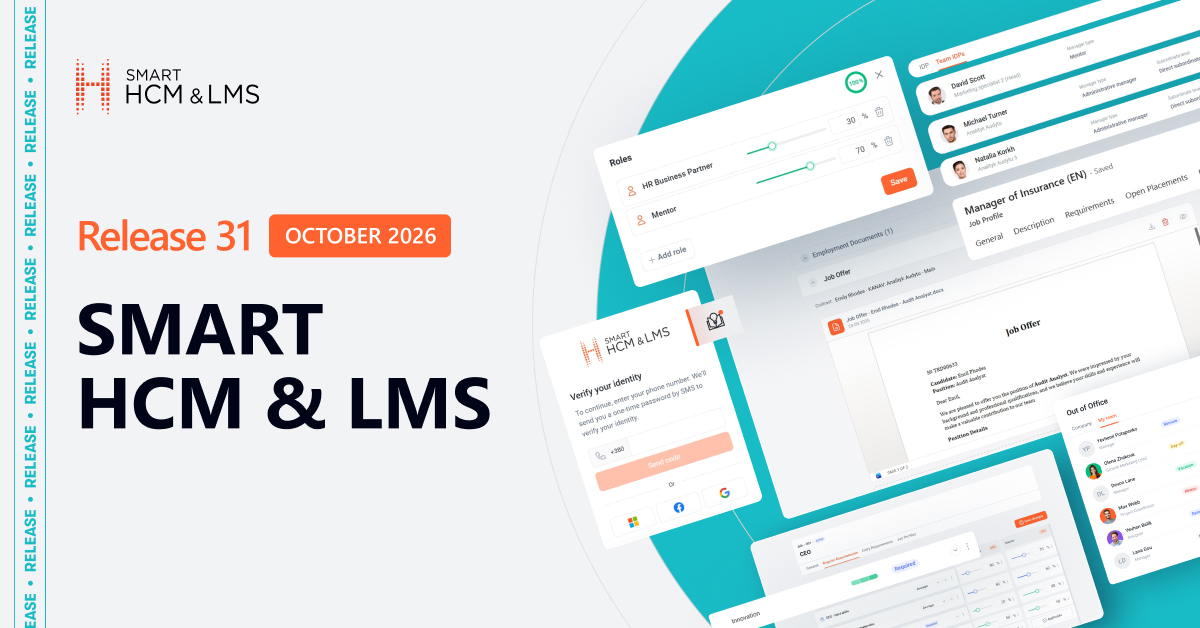
SMART business helps organizations move from isolated HR initiatives to end-to-end HR process automation. SMART HCM & LMS brings together recruitment, onboarding, learning, performance management, employee development, analytics, and self-service capabilities within a unified HR ecosystem built on Microsoft technologies. If you’d like to identify which HR trends offer the greatest value for your organization, submit a request — the SMART business team will help you choose the solution that best fits your goals.